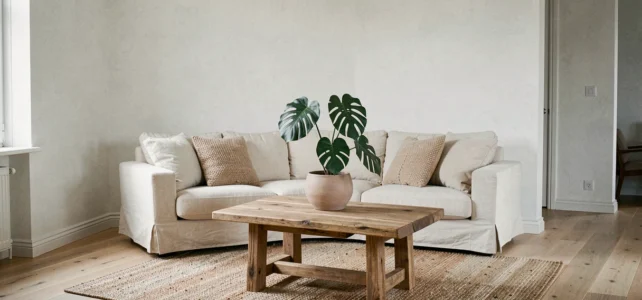
Modern interior decoration is no longer limited to a flat white surface and three straight lines. Since the end of the strict minimalist cycle, interiors are gaining texture, warmth, and uniqueness, without sacrificing the formal rigor that distinguishes a well-executed project from a mere assembly of trends.
REACH Regulation on Formaldehyde and Interior Furniture Choices
The European REACH regulation imposes a limit on formaldehyde emissions for wood-derived panels and the furniture that contains them, effective from August 2026. This change significantly impacts anyone selecting new furniture.
Particle boards, MDF, and plywood used in storage units, bookshelves, or sofa structures are directly affected. Checking REACH compliance before any panel furniture purchase becomes a project reflex, not just an administrative detail.
In practice, we recommend favoring manufacturers who explicitly mention the emission class on their product sheets. Specialized brands like those found on arno-deco.be generally offer ranges that comply with current European standards. Furniture with controlled formaldehyde levels does not stand out visually, but it conditions the air quality in the room over the long term.
Earthy Palettes and Quiet Luxury in the Modern Living Room
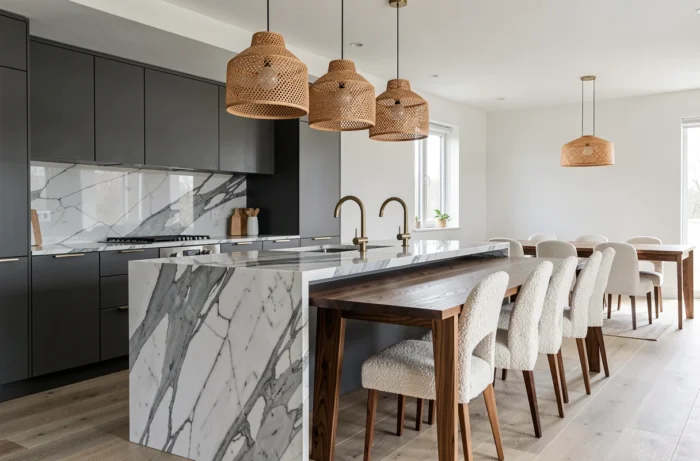
Clinical white is receding. Earthy palettes (clay, terracotta, sand, deep taupe) are establishing themselves as the chromatic foundation of modern and elegant interiors. This shift is not merely a trend: it responds to a search for coherence between materials and colors that all-white did not allow.
Quiet luxury applied to decoration relies on the subtlety of finishes, not their absence. A lime-plastered wall in a greige tone, a sofa covered in washed linen, a brushed brass light fixture: each element is understated, yet its material is discernible.
We observe that this approach works particularly well in open living spaces, where the continuity of warm tones unifies the kitchen-living area without resorting to partitions. A common pitfall is accumulating too much beige without contrast. A single value break is sufficient: a piece of dark wood furniture, a painting with a dominant black hue, a floor in stone darker than the walls.
Layering Materials to Avoid Monotony
- Washed linen and cotton in seating or curtain textiles provide visible texture without decorative overload.
- Solid wood (oak, walnut) in table legs or wall shelves creates a natural anchor against smooth surfaces.
- Brushed metal (brass, patinated steel) in light fixture or handle details introduces a matte sheen that structures the gaze.
- Natural stone or waxed concrete flooring adds density to the whole without introducing color.
Curved Furniture Shapes: Beyond the Living Room Trend
Organic lines in living room furniture are not an aesthetic whim. Curved sofas and round tables alter the flow within the room, which has a direct impact on the perception of space.
A rounded-back sofa, placed as a central island, creates a distinct conversation area without partitioning. A coffee table with rounded corners frees up side passages. In a modestly sized living room, this gain in fluidity is more effective than a compact but angular piece.
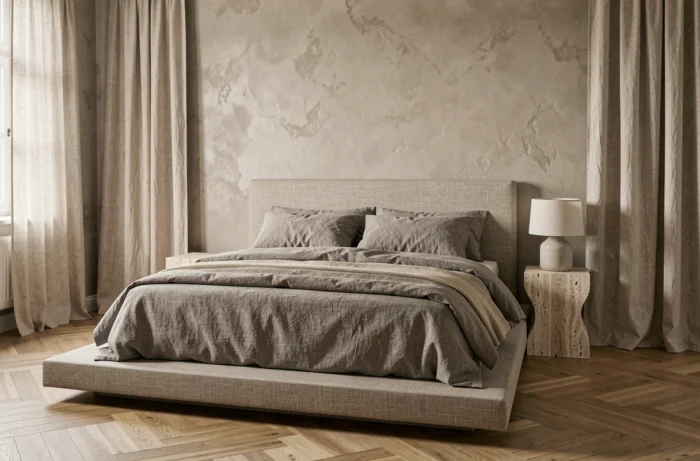
The risk with organic furniture is the loss of rigor. We recommend limiting curves to two focal pieces per room (the sofa and the table, or the armchair and the light fixture) and maintaining straight lines on wall storage and shelves. The contrast between curved and straight lines is what makes a modern interior readable.
Architectural Lighting and Decoration: Common Mistakes
A modern interior decoration project relies as much on light as on furniture. The proliferation of light points is a common piece of advice, but rarely specified in its technical dimension.
Three layers of lighting coexist in a well-thought-out living room:
- General lighting (ceiling light, pendant) sets the base brightness level. Its color temperature should remain consistent with the room’s palette: a warm hue for terracotta interiors, a neutral hue for lighter spaces.
- Accent lighting (adjustable spots, directional wall sconces) highlights a specific element: a painting, a niche, a wall texture.
- Ambient lighting (table lamp, indirect LED strip) creates depth in the evening. This layer gives a living room its character at night.
Mixing color temperatures in the same room disrupts coherence. A cold light ceiling fixture combined with a warm table lamp creates a visual discomfort that most occupants feel without identifying it.
Positioning Sources in an Open Living Room
In a kitchen-living space, we place the main source above the dining area rather than at the geometric center of the ceiling. The sofa corner works better with low sources (arc floor lamp, reading lamp) that visually delineate the relaxation area.
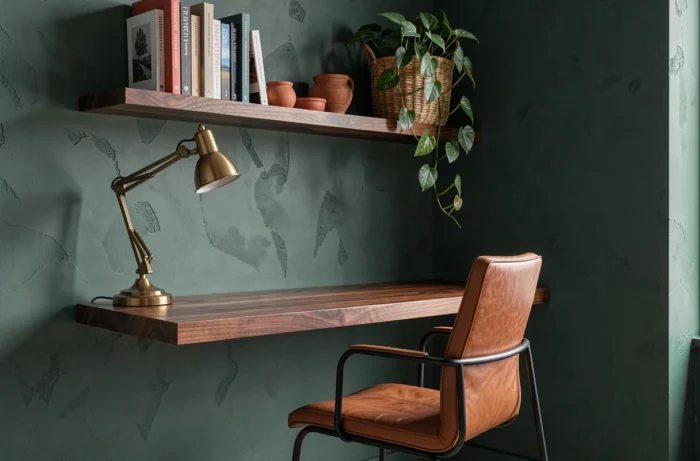
A dimmer on general lighting transforms a single-use living room into a versatile space. It’s a minimal investment that radically changes the atmosphere of a room depending on the time of day.
Modern and elegant interior decoration relies less on the accumulation of design objects and more on mastering a few structuring parameters: coherence of materials, rigor of the palette, and quality of lighting. An interior where these three axes are aligned remains readable for years, well beyond trend cycles.