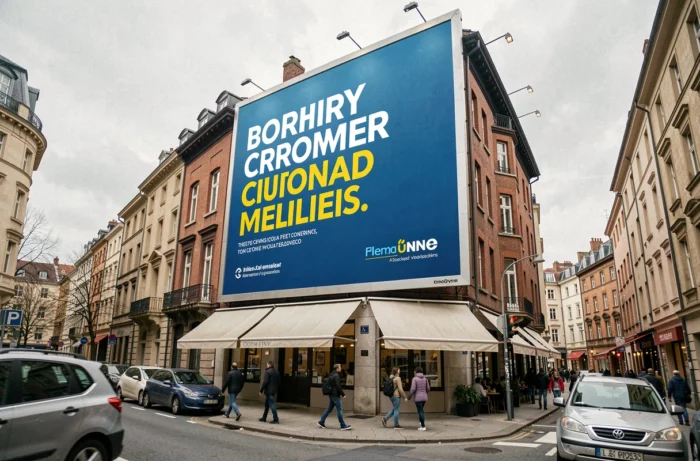
A neighborhood business puts up a poster on a 4×3 panel two streets away from its shop. Within a week, store visits increase without any digital campaign being launched. This type of result is regularly observed in the field, reminding us that advertising displays remain a concrete lever for generating physical traffic.
Regulatory constraints of advertising displays in France
Before choosing a location or format, one encounters a legal framework that varies from one municipality to another. Since the Climate and Resilience Law of 2021, local advertising regulations can govern screens installed inside shop windows: authorized surface area, blackout hours, energy consumption, light pollution.
In practice, there is no uniform rule applicable across the entire territory. A sign allowed in a suburban commercial area may be refused in a historic city center. We recommend consulting the local advertising regulation (RLP) of the targeted municipality before any investment in furniture or screens.
This constraint, far from being a hindrance, forces better targeting of locations. And when one understands the advantages of advertising displays, one realizes why this compliance effort is worthwhile: each well-positioned panel works continuously, without cost per click or algorithm to monitor.
Dynamic and programmatic displays: what technology changes
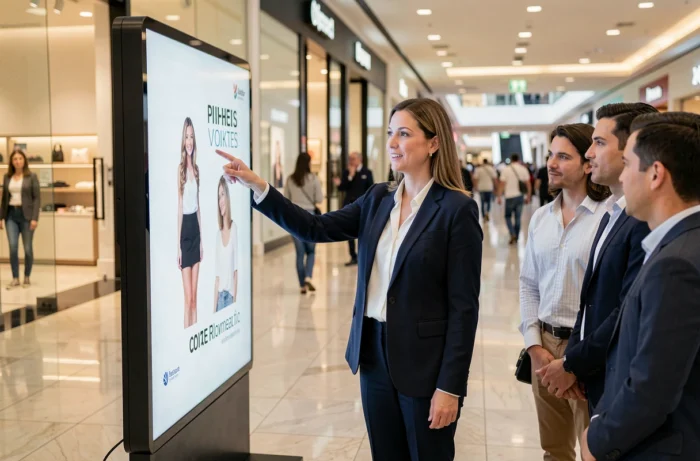
Advertising displays are no longer limited to a paper poster stuck on a panel. Dynamic screens (DOOH, or Digital Out-of-Home) allow for content tailored to the time, weather, or profile of the catchment area. We move from a fixed message to real-time modifiable communication.
Programmatic buying accelerates this transformation. According to the global study by the World Out of Home Organization published in September 2026, France had 16.7% programmatic penetration in 2025. This figure reflects a growing automation of screen purchasing, although the French market still lags behind the most advanced countries.
Concrete benefits of DOOH for businesses
For a local business or a national brand, dynamic screens provide clear operational benefits:
- Remote content updates, without printing costs or the need to send an installer. A promotion can be modified in minutes from a centralized management software.
- Rotation of multiple campaigns on the same screen, reducing the unit cost per message displayed and allowing for testing different visuals.
- Integration of contextual data (time, temperature, local event) to automatically adapt the displayed message to the actual situation of passersby.
Feedback varies on this point, but several brands find that dynamic visual rotation captures attention better than static displays, especially in high foot traffic areas.
Measuring the real impact of an advertising campaign
Advertising displays are often criticized for being difficult to measure compared to digital. This criticism was valid ten years ago. It is much less so today.
DOOH campaigns are now evaluated using methods like GeoLift, which compare exposed areas to control areas to estimate actual additional visits or sales. The principle: isolate the effect of the panel by neutralizing other marketing variables.
DOOH is transitioning from a brand awareness medium to a measurable performance medium. However, industry professionals emphasize that proving an incremental effect remains more complex than for search or SMS. We are not yet talking about the same level of data granularity, but the trend is clear.
Indicators to track for managing campaigns
- In-store traffic during and after the display period, compared to a control period without a campaign.
- Changes in brand searches on engines in the geographic area covered by the panels.
- Recall rate measured by post-test surveys among a sample of exposed passersby.
- Cost per thousand contacts (CPM) related to the estimated number of passersby in front of the panel, a classic but still useful indicator for comparing locations.
Advertising displays and multichannel strategy: the role of the window
In practice, it is observed that displays rarely work alone. Their effectiveness increases when they are part of a system that combines window communication, digital presence, and in-store activation.
An advertising panel captures attention. The window extends the message and triggers entry into the shop. For businesses with a point of sale, the screen in the window becomes a natural relay of the outdoor campaign. The passerby sees the panel from 200 meters away, then finds the same visual or a complementary offer on the window screen.
This visual consistency between the panel and the window enhances recall. It also conveys a sense of seriousness: a business that masters its external communication inspires more trust than a brand whose messages vary from one medium to another.
Advertising displays do not need to be the most sophisticated channel in your marketing mix to produce results. They need to be well-positioned, compliant with local regulations, and articulated with your other media. When these three conditions are met, the panel remains one of the few media capable of reaching an audience that hasn’t asked for it, without the ability to scroll, close, or block the message.