Buying a teardrop kit means buying a project as much as a recreational vehicle. The French-speaking market today offers several options, from pre-cut plywood panels to complete chassis delivered with hardware. Prices, levels of finish, and especially regulatory constraints vary from one manufacturer to another, sometimes radically. Before comparing kits, it is essential to understand what French legislation actually imposes on a self-builder.
Single Vehicle Approval and Gas Standards: What the DREAL Requires from a Self-Built Teardrop
Competing articles detail the necessary tools and assembly time. They rarely mention the next step: legally driving a trailer assembled in a garage on the road.
In France, road trailers of category O, including caravans, must be approved. A teardrop built from a kit may require a single vehicle approval (RTI) from the DREAL before any registration. The procedure involves a technical file, a physical inspection of the vehicle, and verification of compliance with current standards.
For kits equipped with a stove or gas heating, the NF EN 721 and NF EN 1949 standards apply. Without gas equipment, NF EN 721 remains applicable. A kit delivered without usable technical documentation for the DREAL complicates the process significantly, and some foreign manufacturers do not provide a file suitable for the French framework.
This point is rarely a selling argument, but it conditions everything else: without registration, no circulation, no insurance, no camping.
GVW, Payload, and the 500 kg Threshold: The Real Comparison Criteria for a Teardrop Kit
Comparing the best teardrop kit models based solely on empty weight gives a misleading picture. The determining legal criterion is the GVW, the maximum authorized weight in load. This figure includes the structure, but also water, the auxiliary battery, the spare wheel, luggage, and all accessories added after assembly.
A teardrop advertised as lightweight may offer a very limited payload once equipped with a kitchen, a tank, and a solar panel. Field reports vary on this point: some owners find that only a few dozen kilograms of margin remain before reaching the GVW.
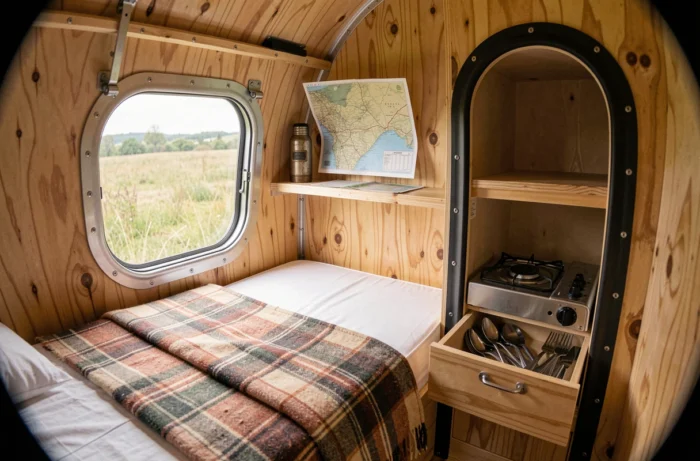
The regulatory threshold of 500 kg also changes the administrative game. A trailer with a GVW exceeding 500 kg must have its own registration document and its own license plate. Below or at 500 kg, it generally uses the plate of the towing vehicle, which simplifies the procedures.
It is also necessary to check compatibility with the towing vehicle. The GVW of the trailer and that of the vehicle must remain within the limit of the GTW indicated on the registration document. A standard B license allows a combination where the total vehicle + trailer does not exceed 3,500 kg, but additional restrictions exist depending on the 96 mention or the BE license.
Points to Check Before Choosing a Kit
- The GVW announced by the manufacturer and the actual payload once the setup is complete (water, battery, kitchen, storage)
- The compatibility between the GTW of your towing vehicle and the GVW of the loaded teardrop
- The presence or absence of a usable technical file for DREAL approval, especially for kits imported from outside the European Union
- The type of license required: simple B, B mention 96, or BE, depending on the total weight of the combination
Trailer and Teardrop Kit Insurance: A Persistent Blur
Insuring a self-built teardrop does not always happen with a few clicks. Traditional insurers offer trailer contracts, but most require a registration certificate and a registration document. Without a validated RTI, the contract may be refused or limited to very restrictive third-party coverage.
For models with a GVW below the 750 kg threshold, some insurers consider the teardrop covered by the insurance of the towing vehicle, provided it is declared as a trailer. The available data does not allow for a conclusion on uniform practice: conditions vary from one insurer to another, and the boundary between “converted trailer” and “caravan” is interpreted differently depending on the contracts.
A preliminary call to the insurer with the technical description of the kit avoids unpleasant surprises at the time of a claim.
Wood Kits, Aluminum Kits, Composite Kits: What Material for What Use
The choice of the main material structures the entire assembly and onboard living experience. Marine plywood kits, often digitally cut, are appealing due to their accessibility: assembly resembles a large puzzle and does not require welding. However, wood requires rigorous treatment against moisture, and durability directly depends on the quality of the sealing applied by the amateur builder.
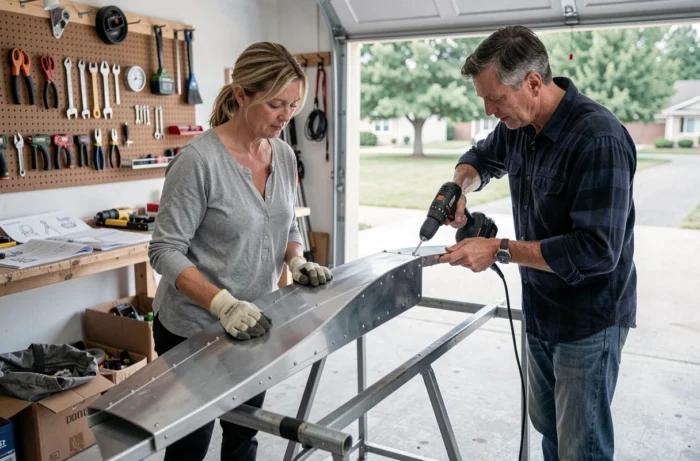
Aluminum structure kits offer better weather resistance and a favorable weight/rigidity ratio. Assembly requires skills in riveting or bolting, and the necessary tools are more specific. Composite kits (fiberglass, foam sandwich) remain minority in the teardrop kit market but are gaining ground for their lightness and thermal insulation.
- Marine plywood: accessible assembly, moderate cost, regular maintenance required for sealing
- Aluminum: superior durability, controlled weight, more technical assembly
- Composite: excellent insulation/weight ratio, limited availability in kits, generally higher price
The material also influences the final GVW. A wood kit equipped with the same kitchen and tank as an aluminum kit will not display the same empty weight, and thus not the same payload margin.
Before ordering a kit, the most reliable approach remains to contact your regional DREAL to confirm the feasibility of approval, then check with your insurer that the chosen model can be covered. An attractive kit in the catalog can become an administrative headache if these two steps are ignored. The pleasure of building your teardrop is worth a few preliminary phone calls.