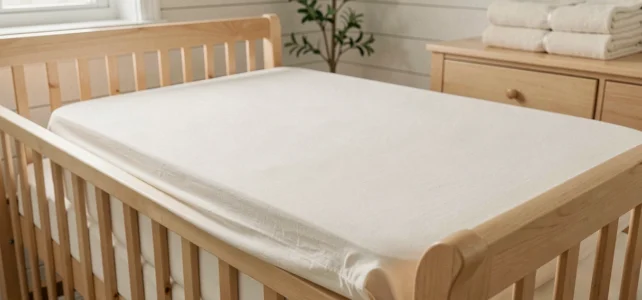
Organic cotton, French manufacturing, textile certifications: what concrete criteria can differentiate brands offering an organic cotton fitted sheet for a baby’s bed? Not all labels guarantee the same thing, and new European regulations are raising the standards even further. This article compares the parameters that really matter before making a purchase.
European regulations on baby textiles: what changes in 2026
The regulatory framework applicable to children’s textiles is tightening. The regulation (EU) 2023/1464 sets a formaldehyde emission limit of 0.080 mg/m³ for textiles placed on the market from August 6, 2026. This threshold directly concerns bedding installed in baby rooms.
At the same time, the General Product Safety Regulation (GPSR, regulation (EU) 2023/988) requires manufacturers to conduct documented risk assessments, maintain a technical file, and provide a declaration of conformity for each textile item intended for children. French brands that control their production chain have an advantage: they can more easily manage the traceability required by these texts.
Another restriction to watch for: the regulation (EU) 2024/2462 prohibits PFAS of the PFHxA type above certain thresholds in consumer textiles starting October 10, 2026. A fitted sheet treated with a water-repellent or stain-resistant finish could be affected. Brands that work with raw organic cotton, without chemical finishing treatments, naturally escape this constraint.
Choosing a baby organic cotton fitted sheet made in France with a GOTS or Oeko-Tex certification remains the most straightforward way to anticipate these regulatory obligations.
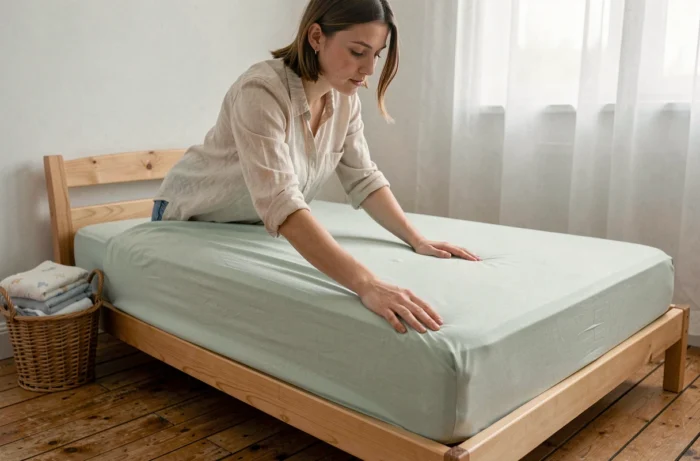
Comparison of French brands of organic cotton baby fitted sheets
The criteria considered below focus on cotton certification, manufacturing location, weaving type, and compatibility with standard baby mattress dimensions (60×120 cm and 70×140 cm).
| Brand | Cotton Certification | Weaving | Manufacturing | Baby Sizes |
|---|---|---|---|---|
| Kadolis | GOTS | Jersey | France | 60×120, 70×140 |
| La P’tite Manufacture | GOTS | Percale | France | 60×120, 70×140 |
| Élise (Marques de France) | GOTS | Percale | France | 60×120 |
| Little Crevette | Oeko-Tex | Jersey / satin | France or Portugal | 60×120, 70×140 |
| Wesco (bio range) | GOTS | Jersey | France | Crib 130×54 |
The distinction between GOTS certification and Oeko-Tex certification deserves attention. GOTS (Global Organic Textile Standard) certifies the entire supply chain, from cotton cultivation to manufacturing. Oeko-Tex Standard 100 verifies the absence of harmful substances in the finished product, without imposing constraints on the cultivation method. For a fitted sheet in prolonged contact with an infant’s skin, GOTS offers a more comprehensive level of guarantee.
Percale or jersey: which weaving for an organic cotton baby fitted sheet
The choice of weaving affects the sheet’s behavior in daily use. Organic cotton percale offers a cool and smooth feel, suitable for warm months. Its tight weave (plain weave) gives it good durability after repeated washes. However, percale lacks elasticity: the sheet must be perfectly sized to avoid slipping on the mattress.
Organic cotton jersey, knitted and not woven, stretches in both directions. It fits better on mattresses of various shapes and easily returns to place after each change. Its slightly plush texture is well-suited for sensitive skin.
- Percale: superior resistance to pilling, quick drying, visually sharper finish
- Jersey: stretchability that facilitates fitting, immediate softness without break-in period
- Organic cotton satin: rarer in baby size, silky feel but slippery, less support on a small mattress
For use in daycare or communal settings, jersey prevails because staff change sheets several times a day and need a cooperative fabric. At home, percale remains a solid choice if the mattress dimensions match exactly with those of the sheet.
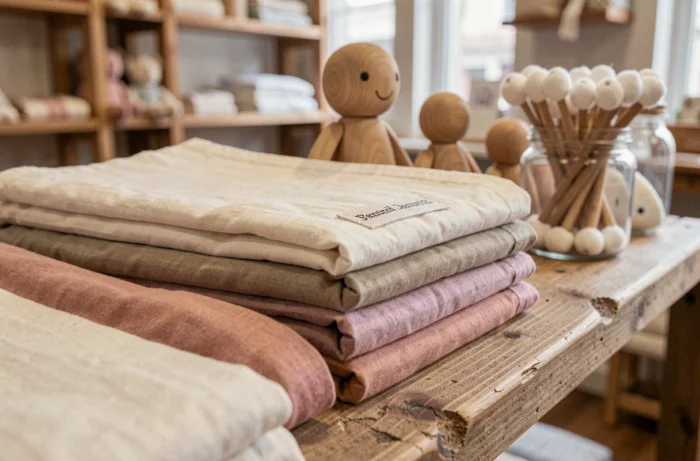
Quality criteria to check before purchasing a baby fitted sheet
Beyond the material and label, several technical details separate a reliable fitted sheet from a model that will cause problems after a few washes.
- Bonnet height suitable for mattress thickness: a bonnet that is too short will detach during the night, while a bonnet that is too deep will create folds under the baby’s back
- Complete peripheral elastic (on all four sides) rather than just at the two ends
- Dense enough grammage to withstand frequent washes without becoming transparent
- Dyes certified free from heavy metals, verifiable via the GOTS or Oeko-Tex license number of the manufacturer
The mention “organic cotton” alone, without a verifiable certification number, has no legal value. Demanding the GOTS or Oeko-Tex license number allows for verification of the certificate’s validity directly on the public databases of the certifying bodies.
French manufacturing and traceability of organic cotton
Manufacturing in France does not mean that the cotton is grown in France. Almost all organic cotton used by French brands comes from India, Turkey, or Egypt. However, French manufacturing guarantees control over the cutting, sewing, and finishing stages, as well as compliance with European labor laws.
Brands that display complete traceability from fiber to finished product allow tracking back to the spinning mill and sometimes even to the agricultural cooperative. This transparency facilitates the compliance verification required by the GPSR regulation, which demands a documented technical file for each reference placed on the European market.
The price of an organic cotton fitted sheet made in France remains significantly higher than an imported equivalent. The gap is explained by labor costs, but also by lower production volumes that limit economies of scale. This extra cost supports a local textile industry and makes regulatory compliance easier to audit.
The new European obligations regarding formaldehyde, PFAS, and general product safety make traceability and certification more crucial than ever in choosing a fitted sheet for babies. Prioritizing a certified GOTS French brand, with a verifiable license number and a weaving suitable for the actual use of the sheet, remains the most reliable selection filter.