
The online cosmetics market generates colossal search volumes each year, driven by increasingly shorter trend cycles. Between viral launches on TikTok, AI skin diagnostics, and hybrid formulas, identifying a truly trendy beauty product before it saturates search results requires a method. The signals to watch vary depending on whether one is looking for skincare, makeup, or a fragrance.
Social signals and search data: spotting a beauty trend before saturation
A beauty product becomes recognizable as an emerging trend when two types of data intersect: organic mentions on social media and still low Google search volumes for the same term.
A product starts to “trend” when it accumulates organic mentions on TikTok or Instagram without yet being covered by major beauty media. At this stage, Google queries associated with the product name or ingredient are still low. It is precisely this window that allows for spotting a trend before it becomes saturated.
To capture these signals, several concrete approaches work:
- Monitor niche hashtags on TikTok (less than 50,000 cumulative views) rather than generic hashtags like #skincare or #makeup, which are already cluttered with sponsored content
- Cross-reference with Google Trends by filtering by country and recent period: an ingredient that has been rising in searches for two to three weeks without strong editorial results signals a window of opportunity
- Observe launches on independent brand sites before they appear at general retailers
This method requires regular monitoring. Online beauty trend cycles are now counted in weeks, not months. A viral product can go from discovery to saturation in less than thirty days.
For those who prefer a pre-filtered selection of cosmetic products in line with current trends, exploring the Babioles Beauté site can save time on this monitoring.
Virtual diagnostics and augmented reality try-on: what it really changes
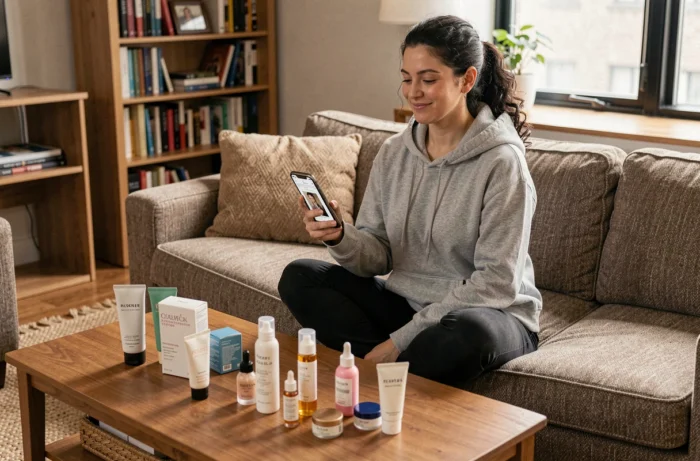
Photo diagnostic tools and virtual try-on (AR try-on) are multiplying on online cosmetics sites. Their promise: personalize the discovery of beauty products based on skin type, complexion, or texture preferences. In practice, their reliability remains variable.
AI diagnostics analyze a photo of the face to suggest a routine or suitable product. Some are limited to a questionnaire dressed in technological packaging, while others genuinely incorporate computer vision to assess skin condition. Field feedback varies on the accuracy of these tools, especially for darker skin tones or combined issues (acne and dehydration, for example).
Virtual try-on works better for makeup than for skincare for a simple reason: a lipstick or eyeshadow is immediately visible on screen, while a serum does not have an instant visual rendering. Brands investing in AR try-on therefore primarily target makeup and hair coloring categories.
What to remember: these tools are useful for reducing the risk of purchase errors regarding shades and textures. They do not replace a real test to evaluate skin tolerance or the effectiveness of a treatment over several weeks. A virtual diagnostic guides discovery; it does not validate a product.
Trending beauty categories online: what is really rising
Several beauty product categories are gaining search volume in the recent period, with distinct dynamics according to segments.
Expressive makeup and maximalism
The shift is clear: after several years of minimalist “clean girl” aesthetics, searches are turning towards maximalism and color. Graphic eyeshadows, shiny textures, layers of pigments: makeup is becoming a field of artistic expression again. This shift is reflected in an increase in searches for terms like “artistic makeup,” “bold makeup,” or “color blocking face.”
Skincare with visible and non-invasive effects
On the skincare side, interest is focused on products with quickly perceptible results, without going through in-office procedures. Firming or lifting effect formulas are capturing attention, at the expense of ten-step routines that are losing ground. Consumers want visible results with fewer products.
Fragrance, clean formulas, and hybrid products
Three categories are rising in search without being systematically covered by generalist sites:
- Fragrance, driven by a niche perfume culture that is expanding to the general public via social media
- Clean, vegan, and non-toxic formulas, which are no longer a niche argument but a standard filtering criterion for a growing share of online customers
- Hybrid products like “skincare-infused” foundations or tinted SPFs, which respond to a demand for simplifying routines
Reliability of online reviews on cosmetics: what the data allows us to verify
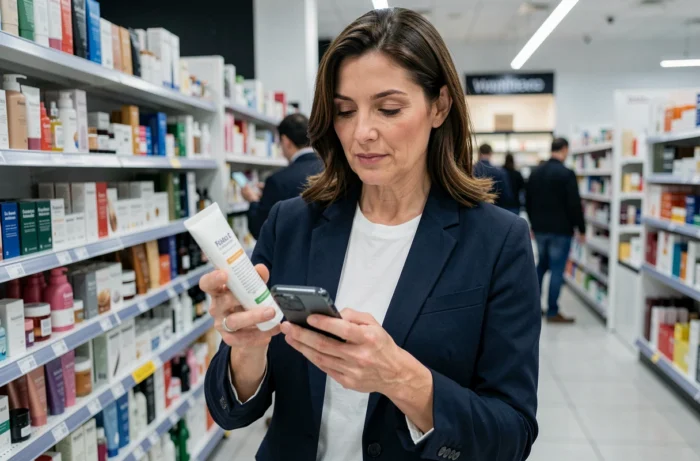
Buying a trendy beauty product online almost always involves consulting reviews. The challenge lies in sorting between authentic feedback and sponsored or generated content.
A first filter is to check the date and diversity of reviews. A product with only five-star reviews posted in the same week is a red flag. Serious platforms display verified reviews (confirmed purchase) and make negative feedback visible.
Cross-referencing sources remains the most reliable method: comparing reviews on the brand’s site, on a third-party retailer, and on a dedicated forum or subreddit. Feedback on Reddit or specialized Facebook groups is often more detailed and less filtered than that from merchant sites.
The available data does not allow us to conclude that one platform is systematically more reliable than another. However, the presence of detailed reviews mentioning skin type and duration of use is a more relevant quality indicator than the average rating.
The most useful reflex before buying a beauty product spotted online remains to check if the feedback mentions results after several weeks of use, and not just a first impression upon opening the package. Longevity and skin tolerance matter more than texture or packaging.