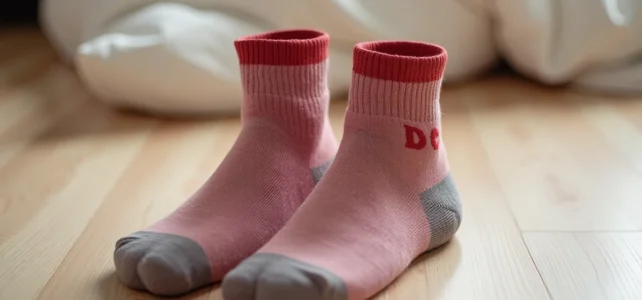
Some socks are designed for a specific foot, with reinforcements, seams, and a fit that differ between the left and right sides. Putting them on the wrong way negates some of their benefits in terms of comfort and support. Quickly identifying which sock goes on which foot also prevents unnecessary bunching inside the shoe, a common source of blisters during running or prolonged walking.
L and R Marking on Socks: What These Letters Conceal
Most anatomical socks, whether intended for running, hiking, or compression, feature an L (left) and R (right) marking woven or printed on the sole, arch, or top of the foot. This marking is not decorative: it indicates that the sock has been constructed on a different template for each foot.
The reinforcement zones are not placed in the same location. On the right foot, the main friction with the shoe concentrates on the outer edge of the forefoot, while on the left foot, the inner support area is more engaged. The flat seams are oriented so as never to cross the toes on the wrong side.
To identify them when putting them on, the most reliable gesture is to turn the sock inside out and look for the letter on the arch. When one wants to differentiate between left and right socks without wasting time in the morning, spotting this area becomes a reflex in just a few days.
Some brands place the marking at the top of the foot, just below the elastic. Others use a different colored thread on each sock instead of a letter. The location of the marking varies by brand, which requires checking once where it is before storing the pair.

Socks Without Marking: Visual Tips to Avoid Confusion
Not all commercial socks have an L/R indication. Basic models, fancy socks, or pairs for children and babies are often symmetrical. In this case, the question does not arise: they can go on either foot.
However, some socks exhibit slight asymmetry without explicit marking. This is the case for pairs where the toe seam is offset or where the heel is slightly curved. To spot this asymmetry, simply lay both socks flat next to each other and observe the shape of the heel.
Creating Your Own Identification System
When socks are identical in pairs and one has several pairs of the same model, confusion multiplies during laundry sorting. A few simple methods can help remedy this:
- Sew a small colored stitch inside each right sock (one stitch is enough; it remains invisible once the shoe is on)
- Use a fabric marker to draw a small symbol on the inner sole, for example, one dot for the left, two dots for the right
- Pair each sock with a clothespin or sock clip before putting them in the wash to avoid separating them during laundry
These techniques are particularly useful when preparing socks for a child learning to dress independently. A simple visual marker, like a heat-adhesive sticker in the right sock, helps the child associate a foot with a marker without yet knowing how to read the letters L and R.
Compression and Running Socks: Why Inversion Is a Real Problem
For classic cotton socks, inverting left and right has no measurable consequences. The situation changes with technical socks used in running, trail, or for blood circulation.
Compression socks exert a calibrated decreasing pressure: stronger at the ankle, lighter at the calf. When they are anatomical, the pressure distribution differs between the inner and outer edges of the foot. Wearing them inside out reduces the effectiveness of arch support and can create uncomfortable pressure points.
In running, blister-resistant socks incorporate reinforcements at the heel and forefoot calibrated according to the friction paths specific to each foot. A shift of just a few millimeters is enough to move a seam onto a contact area, which, during a long run, promotes the appearance of micro-traumas.

The Quick Test Before Running
Before putting on running socks, place both side by side on a flat surface. The curvature of the heel indicates the inner side of the foot. On most models, the reinforcement for the big toe is wider than that for the little toe, which allows them to be distinguished even without an apparent L/R marking.
If the sock shows no visible asymmetry, it is likely symmetrical. In this case, inversion has no impact. Field feedback varies on this point: some runners feel discomfort even with theoretically symmetrical models, while others perceive no difference.
Personalization and Homemade Marking: An Accessible Trend
Online personalization workshops now allow you to have different text or symbols printed on each sock of a pair. The interface is simple: you upload an image or choose a font, place the design on a template, and the order is made individually, with no minimum quantity.
This option, initially reserved for sports clubs or brands, is becoming a practical solution for individuals who want immediate identification. For example, you could have an outward-facing arrow embroidered on each sock, or a distinct pattern (star on the left, circle on the right).
For families with multiple children wearing similar shoe sizes, combining a color code for each child and an L/R marking for each foot greatly simplifies sorting after laundry. A colored thread sewn by hand serves the same purpose at no cost.
Sorting socks remains a common household irritant, but solutions exist at all budget levels. A simple colored stitch costs less than a pair of anatomical socks, and solves the problem for months. For feet stressed by sports or medical compression, investing in models clearly marked L/R remains the most reliable method.