
The European Health Insurance Card (EHIC) can be ordered in just a few clicks from the Ameli account, but a significant number of insured individuals have never activated this account or do not have a FranceConnect identifier. This situation does not prevent obtaining the card: the telephone and physical channels remain fully operational, with specific processing details that the usual guides overlook.
Provisional Replacement Certificate: The Unknown Safety Net
The Provisional Replacement Certificate (PRC) covers exactly the same benefits as the plastic EHIC. Its validity is limited to three months, compared to two years for the standard card, but it can be issued within a few days, sometimes on the same day at the CPAM counter.
Many insured individuals mistakenly believe that the PRC is reserved for emergency situations. Anyone who requests an EHIC and whose production time exceeds the departure date can obtain this certificate, whether the request was made by phone, in person, or through a third party.
The document is provided in paper form and must be presented to healthcare providers in the host country under the same conditions as the card.
Knowing how to request the European Health Insurance Card in advance allows for anticipating this scenario and avoiding leaving without coverage.
The PRC is particularly useful for insured individuals without an Ameli account, as the digital ordering process (the fastest) is inaccessible to them. Simultaneously requesting the EHIC and the PRC at the counter is the most reliable strategy to avoid being left without coverage in case of postal delays.

Requesting EHIC by phone at 3646: Procedure and Limitations
The 3646, the unique number for Health Insurance, allows ordering an EHIC without any digital access. The call is charged at the price of a local call. An advisor verifies the caller’s identity using the social security number, date of birth, and registered postal address.
The card is then sent by mail to the declared home address. No address changes can be processed during this call if the insured has not previously reported their change of address to their fund. This is a common bottleneck: an outdated address in the CPAM file delays or prevents the receipt of the card.
Actual Mail Receipt Time
Health Insurance recommends making the request at least fifteen days before departure. This timeframe covers the processing of the request and postal delivery. In practice, we recommend allowing three weeks, especially during the summer period when CPAM handles a significantly higher volume of requests.
If the card does not arrive on time, the advisor at 3646 can direct the insured to their local fund to collect a provisional certificate in person.
Request at CPAM Counter Without Ameli Account: Documents and Particularities
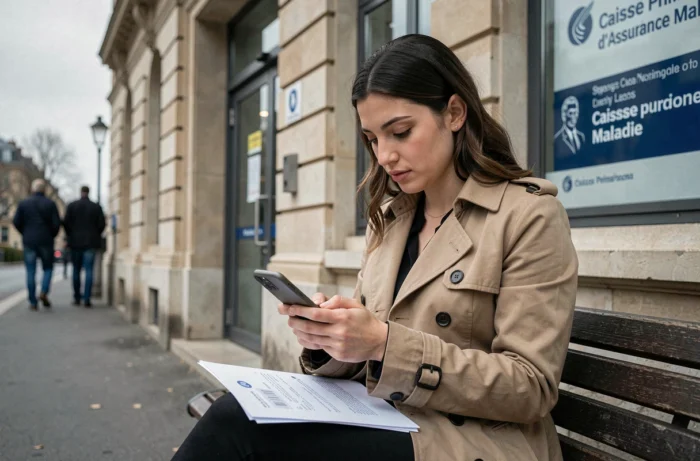
Going directly to a CPAM agency remains the most direct channel for insured individuals excluded from digital access. The request is made on-site, without an appointment at most funds, but some branches now operate on an appointment-only basis. Checking the reception mode of your agency before going avoids an unnecessary visit.
Documents to present at the counter:
- A valid identification document (national identity card or passport).
- The Vitale card, or if not available, a printed rights certificate or a recent reimbursement statement proving affiliation.
- The dates and destination of the planned stay, so that the agent can verify that the country is indeed covered by the EHIC (EU countries, European Economic Area, Switzerland).
Adult dependents must make their own request. A spouse or child over 18 attached to the file of a main insured cannot have their EHIC ordered by the latter without a power of attorney or their presence.
Special Regimes Cases
Affiliates to a special regime (CRPCEN for notary clerks, CNMSS for military personnel, MSA for agricultural operators) do not depend on CPAM. Their EHIC requests go through their own fund, with different forms and portals. The absence of an Ameli account is the norm here, as Ameli is the portal for the general regime. These funds all offer telephone access and a physical counter to order the card.
Actual Coverage of the EHIC Abroad: What the Card Does Not Cover
The EHIC guarantees coverage for medically necessary care in the host country, according to local legislation. This means that the level of reimbursement depends on the country, not the French scale. In a country where the out-of-pocket expenses for residents are high, the EHIC does not cover the difference.
Covered care includes medical consultations, urgent dental care, hospitalizations, pregnancy, and childbirth. However, the EHIC does not cover:
- Medical repatriation, which requires additional travel insurance.
- Scheduled care in another country (medical tourism), unless prior agreement from CPAM via form S2.
- Care in a country outside the EU, EEA, or Switzerland, even if bilateral agreements exist with certain states.
Presenting the EHIC does not always exempt from upfront costs. In some countries, the patient pays for care and then requests reimbursement from the local social security body or from their CPAM upon returning to France. Traveling with a copy of the rights certificate in addition to the card remains a useful precaution, especially when the EHIC has been obtained through a non-digital channel and its late receipt leaves little room for verification.