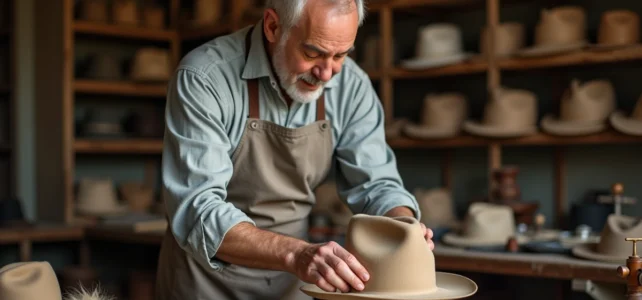
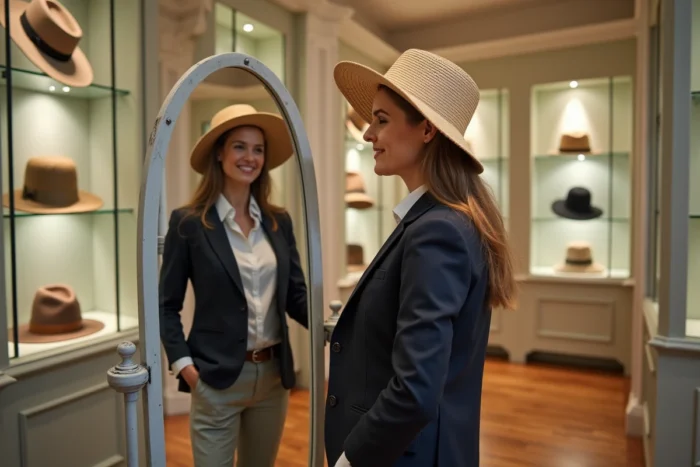
When you enter a hat shop and a professional guides you towards the shape that suits your face, you are facing a hat maker. This title encompasses a precise know-how, distinct from simple selling: the hat maker shapes, adjusts, and advises. Their work relies on mastering living materials such as felt or straw, and on a fine understanding of volumes.
Hat maker in store: an artisan who produces and sells
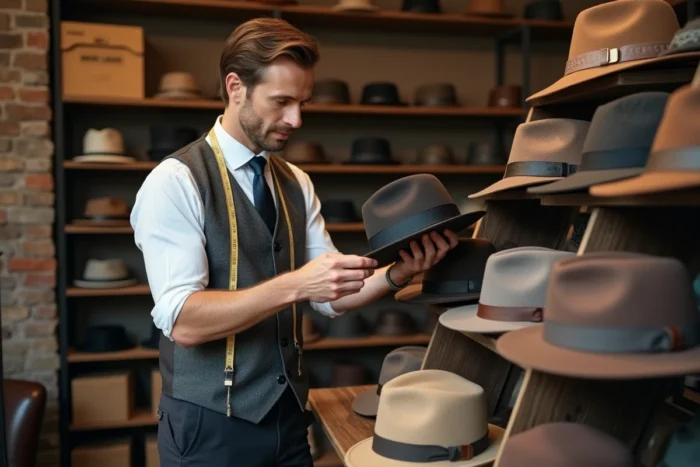
Most job descriptions depict the hat maker as a manufacturer. This is true, but incomplete. In a shop-workshop, the hat maker combines production and customer contact. They take head measurements, offer fittings, and adjust a head entry in real time.
This dual role (the term is fitting) distinguishes the hat maker from a typical ready-to-wear seller. When you buy a rabbit felt hat in a Parisian workshop, the person who welcomes you is often the one who molded the bell on a linden wood form a few days earlier. To better understand the profession of hat maker, one must realize that selling is just one step in a complete artisanal process.
The hat maker masters every step, from molding to selling. This versatility explains why specialized shops remain places where technical advice takes precedence over merchandising.
Felt, straw, and finishing: the technical gestures of the hat maker
Have you ever noticed that a felt hat retains its shape even after years? This result is due to three steps that the hat maker repeats for each piece.
Steam molding
The raw material, a felt bell (rabbit, beaver hair, or wool), arrives shapeless. The hat maker softens it with steam, then stretches it over a wooden form. Steam makes the felt malleable without damaging the fiber. The choice of wooden form determines the final silhouette: wide-brimmed, fedora, retro bell.
Ironing and finishing
Once the shape is obtained, the hat maker fixes the volume with a hot iron. This gesture gives the felt its matte or shiny appearance depending on the pressure applied. Then comes the finishing, an application of textile product that stiffens the structure.
- Molding defines the volume and silhouette of the hat on a linden wood form
- Ironing fixes the material and allows for a choice between a matte or shiny finish
- Finishing ensures durability over time, even after exposure to moisture
- The finishing touches (ribbon, lining, head entry) personalize each piece for the client
These four gestures form the technical foundation of the profession. A hat maker who runs a shop executes them themselves, unlike a reseller who merely distributes industrial hats.
Hat maker and milliner: a distinction that changes the product
The confusion between hat maker and milliner often arises. The difference does not lie in gender (men on one side, women on the other), but in the type of creation and the techniques used.
The hat maker works with structured materials: felt, braided straw. They use steam, iron, and wooden forms. Their product is a hat in the classical sense, with a defined crown and brim.
The milliner, on the other hand, often starts with softer or composite materials. They sew, drape, and assemble decorative elements. Their creations, called fascinators or ceremonial headdresses, are more akin to sewing and textile sculpture. The hat maker structures the material, while the milliner assembles and drapes it.
In practice, many artisans combine both approaches. A shop may offer felt fedoras (hat maker’s work) and wedding fascinators (milliner’s work). The French Federation of Hat Artisans recognizes both professions as complementary within the industry.
Hat maker training: from CAP to transmission workshop
Why is this profession attracting more and more adults in career transition? Because training pathways have diversified.
The CAP Fashion Trades remains the main entry route. It covers the basics of sewing, pattern making, and working with textile materials. Some schools offer specializations in hat making after this initial diploma.
Outside the school curriculum, direct transmission workshops are multiplying. Established hat makers welcome trainees in their shop-workshops to pass on the gestures of molding and ironing. Workshop training remains the most effective way to acquire the skills of the trade.
The textile arts sector has also seen a more visible economic framework in recent years, highlighting associated training pathways. Hat making fits into this broader ecosystem, alongside embroidery, lace, and weaving.
Craftsmanship and series: the hybrid model of current workshops
Mechanization has not eliminated the hat maker. It has shifted value towards the steps that require manual know-how: fine molding, finishing, and fitting to the client.
Some workshops produce both in small series (standardized forms, industrially pre-molded felt) and unique pieces worked entirely by hand. This hybrid model allows for maintaining a viable commercial activity while preserving artisanal gestures.
The value of the hat maker lies in the finishes and adjustments, not in mass production. In the luxury sector, this logic goes even further: the hat maker works with a development studio and an artistic direction, integrated into a production chain where each step involves a specialized artisan, from the form maker who sculpts the wood to the feather worker who prepares the ornaments.
- The form maker creates the wooden molds on which the hat maker stretches the material
- The feather worker prepares the feathers used for decoration
- The hat maker handles the molding, ironing, and finishing
- The milliner intervenes on ornamental finishes and ceremonial pieces
Places like 19M in Paris also help make these skills visible to the general public through exhibitions and open workshops. Hat making is no longer just a shop activity: it becomes a cultural transmission object.
The hat maker who welcomes you in the shop thus carries multiple roles at once. Artisan, technician, advisor, sometimes trainer. It is this density of skills, rarely visible at first glance, that makes the uniqueness of a profession where each hat sold is also a gesture transmitted.