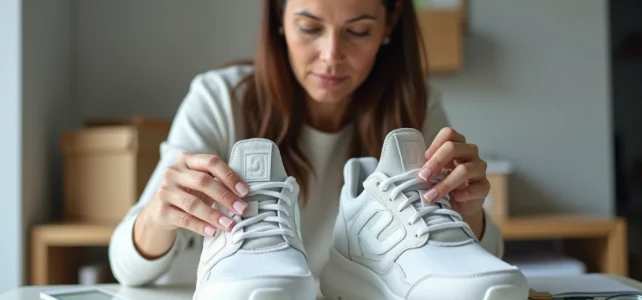
Skechers counterfeits have significantly improved in recent years, to the point of deceiving seasoned buyers. The logo alone is no longer enough to distinguish them. To recognize genuine Skechers, one must examine specific technical details on the sole, labels, and box, then cross-reference with the distribution circuit.
Sole and Finishes of Skechers: The Clues that Counterfeits Systematically Miss
The sole is the first element to inspect. On an original pair, the molded marking under the outsole has clean edges, with no material burrs or misalignment between characters. Counterfeits almost always reveal a molding defect: smudged letters, irregular depth of relief, or inconsistent spacing of text.
We also observe a difference in hardness. Skechers foam (depending on the model: Memory Foam, Ultra Go, Hyper Burst) maintains uniform elasticity across the entire surface of the insole. On a counterfeit, the foam is often denser at the edges and softer in the center, indicating a low-quality injection process.
The stitching connecting the upper and sole follows a regular pitch on original models. On copies, the thread changes thickness or has skipped stitches. This detail is visible to the naked eye on mesh models, where the upper reveals the internal seams.
The finishes of the tongue also deserve scrutiny. The logo embroidered or printed on the tongue of a genuine pair is centered to the millimeter, with a sharp color contrast. Reproductions often show a logo slightly offset to the left or right, or a color gradient that bleeds on the edges. A detailed guide explains how to tell if Skechers are fake by reviewing each area of the shoe.
Interior Labels and SKU Code: The Check Few Buyers Make
Each pair of Skechers has an interior label with an SKU number, a size reference, and a barcode. This trio must be consistent with the information printed on the box. Any discrepancy, even minor (a reversed digit, a size expressed in a different system), indicates a counterfeit.
The label itself provides clues. On originals, it is heat-sealed with smooth edges, with no protruding threads. The text is printed in sharp micro-characters. Fakes often use a poorly sewn label or a heat seal that is already beginning to peel on a new pair.
We recommend checking the SKU directly on the official Skechers website or with customer service. If the number does not match any referenced model, the pair is suspicious. This step takes less than a minute and eliminates the majority of copies.
The Box and Its Markings
The original Skechers box uses consistently thick cardboard, with sharp four-color printing. Counterfeits regularly feature thinner cardboard, a slightly off shade of blue or red compared to the official pantone, and a barcode that does not scan to any product database.
The absence of an original box is a strong warning signal, especially on resale platforms. A seller who ships without a box or in generic packaging often seeks to hide the lack of compliant markings.
Sales Sites and Platforms: Where the Risks of Skechers Counterfeits Concentrate
Skechers counterfeits circulate mainly through three types of channels:
- General marketplaces where any third-party seller can open a shop without thorough verification of their suppliers. Unusually low prices (well below retail) are the first filter.
- Websites with a recent domain name, often registered for less than a year, that mimic the Skechers graphic charter without being authorized resellers. Checking the domain creation date via a Whois tool takes just a few seconds.
- Social media, where sponsored accounts redirect to ephemeral shops. These sites disappear after a few weeks, making any recourse impossible.
Buying on the official Skechers website or from an authorized retailer remains the most reliable method. Authorized resellers are listed on the brand’s official website, in the section dedicated to points of sale.

Product Digital Passport: The Game-Changing Traceability for Skechers
The European regulation on eco-design for sustainable products (ESPR) provides for the establishment of a digital product passport applicable to shoes. This system will document the origin, marketing circuit, and compliance of each pair via a digital medium (QR code, NFC chip, or equivalent).
For Skechers buyers, this traceability will add a level of verification inaccessible to counterfeiters. Scanning a code on the shoe will trace back to the manufacturer and importer, making any copy immediately identifiable.
This digital passport represents a far more robust anti-counterfeiting lever than visual inspection alone. Current guides focus on the logo and stitching, but digital traceability will gradually render these manual checks secondary.
While Waiting for the Digital Passport
As long as this system is not widespread, the combination of three checks remains the most effective: physical inspection of finishes and sole, SKU verification on the official site, and exclusive purchases from authorized resellers. None of these three filters taken in isolation is sufficient, but their intersection eliminates almost all Skechers counterfeits in circulation.