
Organizing a move requires time, energy, and coordination that most households underestimate. The median duration of residence in a home is about 32 months for apartments according to the Clameur observatory, and this duration tends to increase. Fewer moves, but larger accumulated volumes of belongings: the challenge is no longer just logistical; it also becomes financial and administrative. Which areas experience the most delays, extra costs, and tensions on the big day?
1. Measure the actual volume of your belongings before requesting quotes

The majority of disputes with professional movers stem from a discrepancy between the declared volume and the actual volume loaded onto the truck. Underestimating by just a few cubic meters can trigger an additional charge on the same day, with no room for negotiation.
Room by room, list the furniture with their dimensions and the estimated number of boxes. This inventory work, done before contacting a service provider, allows for comparable quotes. Several resources detail these tips for organizing your move well and structuring this often rushed step.
2. Radically declutter to reduce the volume transported

Every cubic meter less in the truck reduces the bill and loading time. A serious sorting distinguishes three categories: what goes to the new home, what is given away or sold, and what is thrown away.
With the lengthening of the duration of residence in homes, the accumulated volumes are often heavier than anticipated. Starting the sorting at least three weeks before the planned date avoids the rush of the last days, which leads to taking everything by default.
3. Compare at least three quotes from professional movers

The price differences between providers for the same volume can vary significantly. A single quote provides no market reference.
| Criterion | Mover A (entry-level) | Mover B (mid-range) | Mover C (premium) |
|---|---|---|---|
| Packaging included | No | Partial (fragile items) | Yes, full |
| Breakage insurance | Declared value capped | Declared value capped | Replacement value |
| Dismantling/reassembling furniture | Extra charge | Included (large furniture) | Included |
| High season period | Variable surcharge | Fixed surcharge | Flat rate |
During the high season (June to September), demand skyrockets and prices rise. Booking several weeks in advance remains the main lever to maintain a reasonable rate.
4. Check the energy performance diagnosis of the future home before signing

Since 2025, homes rated G on the DPE are banned from being rented in France. Signing a lease for a poorly rated property exposes you to quick inconveniences: mandatory work for the owner, or even questioning the lease.
Always check the energy performance diagnosis before committing. This point, often relegated to the background in the frenzy of searching, conditions the thermal comfort and the amount of energy charges in the new home.
5. Anticipate the transfer of home insurance

The transfer of home insurance after a move is not governed by any legal deadline to inform the insurer. This lack of regulatory constraint encourages delaying the process, creating a period of uncertainty where the new home is not covered or the old one remains unnecessarily insured.
Contact your insurer as soon as you sign the lease or sales agreement. Provide the new address, the area, and the number of rooms to adjust the coverage before moving day.
6. Pack fragile items with a protocol by room

Piling plates in a generic box with newspaper remains the leading cause of breakage during a move. Each room in the home deserves a distinct packing treatment.
- Kitchen: individual bubble wrap for dishes, reinforced boxes for appliances, vertical support for stemware
- Living room: protective blankets for screens, covers for sofas, anti-static bags for electronic cables
- Bedroom: wardrobe boxes for clothes on hangers, tissue paper for delicate linens
Labeling each box with the destination room and a brief description of the contents significantly speeds up unloading.
7. Prepare a survival box for the first 24 hours

On the night of the move, finding a toothbrush or a clean sheet at the bottom of an anonymous box turns fatigue into exasperation. A survival box packed last and unloaded first eliminates this problem.
This box contains hygiene products, common medications, phone chargers, a set of sheets, and a few kitchen utensils. Add the administrative documents related to the new home: lease, inventory, meter readings.
8. Negotiate the rent in a tense area using the current rent control

The rent control system in tense areas has been extended until July 31, 2026 (decree no. 2025-652). During a re-rental, the landlord cannot increase the rent beyond the reference rent index (IRL), unless justified renovations are made.
Check the applicable increased reference rent for your new address before signing. This negotiation lever is often underutilized by tenants who move urgently and accept the first amount proposed.
9. Plan address changes in a single session

Spreading address changes over several weeks multiplies the chances of forgetting. Grouping all notifications in a single two-hour session reduces the risk of lost mail or withdrawals directed to an obsolete account.
- Taxes, Social Security, mutual insurance, CAF
- Bank, insurance (home, auto)
- Energy suppliers and internet provider
- Employer, schools
The online service of La Poste allows for tracking mail forwarding for six months to a year, covering the transition period without loss of correspondence.
10. Reserve parking in front of the new home
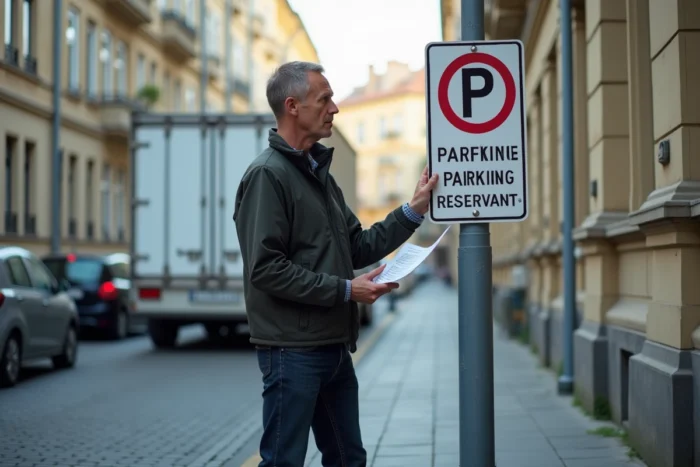
A moving truck double-parked generates stress, fines, and extended carrying time. In most municipalities, a temporary parking permit can be obtained from the town hall with a lead time of a few days to two weeks depending on the city.
Submit the request as soon as the date is confirmed. On the big day, place the no-parking signs the night before to free up the space. This logistical detail, often overlooked, is crucial for the smoothness of the entire unloading operation.
The move concentrates its difficulties on three areas: estimating the volume, the administrative calendar, and coordination on the big day. Addressing these three points in advance, with verified data and a precise inventory, absorbs the majority of unforeseen events that contribute to stress.