
Installing a mailbox on a non-buildable recreational plot is not enough to officially receive mail there. The issue involves postal law, urban planning, and the legal concept of residence, three frameworks that do not always overlap. Before putting up a post and attaching a standardized mailbox, several concrete obstacles need to be identified.
Postal address on non-buildable land: what La Poste really requires
La Poste delivers mail to addresses listed in its database. For a location to be recognized as a distribution point, it must correspond to a address validated by the municipality (road numbering, identifiable cadastre). A recreational plot classified as natural or agricultural in the local urban planning does not generally have an address in the postal sense.
Installing a mailbox at the edge of the plot and notifying the mail carrier, as suggested by some forums, does not create any obligation for La Poste to deliver. Mail can be refused or returned to the sender if the address does not appear in the official reference. Reports from the field vary on this point: some owners report local tolerance from the mail carrier, while others face outright refusal from the post office.
The possibility of receiving mail on a recreational plot thus primarily depends on the administrative status of the plot and its recognition by municipal services, not just the physical presence of a mailbox.

Residence, dwelling, recreational plot: three distinct legal concepts
The civil code distinguishes between domicile (place of principal establishment, article 102) and residence (place of habitual stay). A non-buildable recreational plot cannot legally accommodate a permanent dwelling. Without authorized construction, the plot does not constitute either a domicile or a residence in the legal sense.
This distinction has direct consequences. To obtain a vehicle registration, open a bank account, or register on electoral rolls, one must prove a domicile. A simple mailbox in a field does not provide any acceptable proof of domicile for the administration.
The case of light housing and the ALUR law
The ALUR law introduced the concept of permanent light housing (yurt, tiny house, removable cabin) into the urban planning code. Some municipalities create limited size and capacity sectors (STECAL) in their PLU to authorize these installations, even on initially non-buildable plots.
When a recreational plot is classified as STECAL, the light housing installed there can be recognized as a residence. The occupant then obtains an address, and mail delivery follows. Outside of this framework, the installation of light housing remains subject to urban planning authorization, and the absence of a permit exposes one to legal action.
Right to domiciliation: an unknown solution for recreational plots
Article L.264-1 of the Social Action and Families Code provides for a right to domiciliation for anyone without a stable domicile. In practice, the CCAS (communal social action center) or an approved organization can provide an administrative address to a person living on a non-buildable plot, whether their installation is legal or not.
This domiciliation allows for receiving administrative mail, accessing social rights, and having a proof of address. It does not regularize the situation regarding urban planning, but it resolves the immediate postal issue.
- The application is submitted to the CCAS of the municipality where the plot is located or to an association approved by the prefecture.
- Mail is then received at the address of the CCAS or the organization, not directly on the plot.
- This right applies regardless of the person’s nationality and administrative status.
This procedure remains little used by owners of recreational plots, who do not always consider themselves “without a stable domicile.” Available data does not allow for assessing how many people resort to it in this specific context.
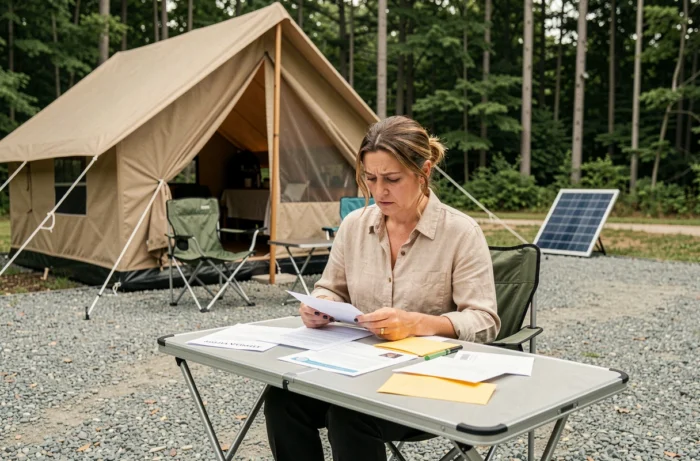
Mailbox on non-buildable land: risks and practical limits
Placing a mailbox on a non-buildable plot is not prohibited in itself. No text specifically penalizes this action. However, problems arise both upstream and downstream.
Upstream: the absence of an official address
Without municipal recognition, the mailbox exists physically but remains invisible to La Poste and delivery services. Registered parcels, administrative mail, and official notifications cannot be delivered to an unreferenced point.
Downstream: the risk of requalification
A regularly emptied mailbox, combined with signs of occupancy (parked caravan, visible developments), can lead the municipality to determine an illegal occupation of the land for residential purposes. Sanctions range from orders to restore the site to fines, according to urban planning code.
- The mere presence of a mailbox does not constitute proof of habitation, but it can serve as an indication in a body of evidence.
- Some municipalities tolerate the situation for years before acting, while others react quickly, especially under pressure from neighbors.
- An infraction report can be drawn up by sworn municipal agents without prior notice.
Concrete alternatives for receiving mail
Several solutions allow for circumventing the absence of a postal address on a recreational plot without violating regulations.
Renting a post office box from La Poste remains the simplest option. It provides a permanent address, accepted by most administrations, and the mail is kept at the post office closest to the plot.
Domiciliation with a third party (friend, family, neighboring owner with a valid address) is another possibility. It requires a written agreement and a hosting certificate, but it works for most common procedures.
Finally, for those who actually live on their plot in light housing, the domiciliation via the CCAS mentioned above remains the most protective route in terms of social rights.
The answer to the initial question can be summed up in one sentence: receiving mail on a non-buildable recreational plot is technically possible but administratively fragile. Without an address recognized by the municipality, no regular delivery is guaranteed, and the presence of a mailbox does not create any rights. Solutions involve parallel arrangements (post office box, CCAS domiciliation, hosting with a third party) rather than direct installation on the plot.